

If you or someone you love has diabetes, you may have asked this question more than once. And the answer actually matters, because it affects your rights at work, your access to benefits, and the support you can ask for. So let me break it all down for you in the simplest way possible.
Is Diabetes Considered a Disability Under Federal Law?
What Does the Law Actually Say?
Yes, diabetes is considered a disability under federal law in the United States. This has been clear since 2009, when important changes were made to the Americans with Disabilities Act (ADA). The updated law says that any condition that substantially limits a major life activity counts as a disability. And diabetes does exactly that, it limits how your endocrine system works.
Your endocrine system is the system in your body that controls insulin and blood glucose (blood sugar). When this system does not work properly, it affects how your body gets energy. Because diabetes mellitus directly affects this system, the law protects people with it just like any other disability.
Both Type 1 diabetes and Type 2 diabetes are covered under this law. It does not matter if your condition is mild or severe. It does not matter if you take insulin or manage it through diet and exercise. You are still protected.
Which Laws Give You These Protections?
The main law is the Americans with Disabilities Act (ADA). But there is also the Rehabilitation Act, which covers people who work for the federal government or work at places that receive federal money. On top of that, many states have their own laws, and if your state law gives you stronger protections than the federal law, you get both.
According to the U.S. Equal Employment Opportunity Commission (EEOC), which enforces these laws, having diabetes means you are protected from discrimination in your workplace, school, and public places.
Type 1 vs. Type 2 Diabetes: Are Both Covered?
Is Type 1 Diabetes a Disability?
Yes, Type 1 diabetes is a disability. With Type 1, the body cannot make insulin at all. This usually starts in childhood or early adulthood. The body attacks its own insulin-producing cells, so a person with Type 1 must take insulin therapy every day to survive. They also need to check their blood sugar levels regularly and plan their meals and activities very carefully.
Because all of this daily management is required just to stay healthy, Type 1 diabetes is classified as a disability under the ADA. This means an employer must give a person with Type 1 diabetes things like extra breaks for glucose monitoring, a safe place to store insulin, or time off for doctor appointments. These are called reasonable accommodations.
I once spoke with someone who had worked in a fast-paced retail job while managing Type 1. She said her biggest challenge was not the disease itself, it was not knowing she had the right to ask for a break when her blood sugar dropped. Once she learned about the ADA, everything changed. She felt seen. She felt protected.
Is Type 2 Diabetes a Disability?
Absolutely. Many people think only Type 1 is serious enough to be called a disability. That is not true. Type 2 diabetes is also a protected disability under federal law, even if you manage it without insulin.
The reason? Your endocrine function is still affected. Your body either does not make enough insulin or does not use it the right way. This still counts as substantially limiting a major body function. According to the American Diabetes Association, this protection applies regardless of how well you manage the condition. So whether you are on oral medication, insulin injections, or controlling things with diet and lifestyle, your rights are the same.
Your Rights at Work: What Can You Ask For?
Reasonable Accommodations at the Workplace
This is where things get really practical. Because diabetes is a disability, your employer must offer you reasonable accommodations, changes that help you do your job without making your health worse. Here are some examples:
You can ask for scheduled breaks to check your blood glucose levels or take insulin. You can ask for a private space where you can do this without others watching. If your blood sugar drops suddenly, you can keep snacks or juice at your desk. If your condition requires morning medical appointments, you may be able to adjust your start time.
These things are not favors. They are your legal rights. Your employer cannot fire you, demote you, or treat you differently just because you have diabetes.
Can Your Employer Ask About Your Diabetes?
This is a question many people don’t know the answer to. Under the ADA, an employer generally cannot ask you if you have diabetes before offering you a job. They can only ask after a job offer is made, and only if they ask all new employees the same health questions. They also cannot use that information to take back the offer unless you cannot do the job even with reasonable accommodations.
Honestly, many people stay quiet about their condition out of fear. But knowing your rights makes a big difference. If an employer treats you badly because of your diabetes, that is called discrimination, and it is illegal.
Can You Get Social Security Disability Benefits for Diabetes?
SSDI and SSI: What Are the Requirements?
Here is where things get a little different. Just having diabetes does not automatically mean you will get Social Security Disability Insurance (SSDI) or Supplemental Security Income (SSI). These are monthly payments from the government for people who cannot work because of a disability.
The Social Security Administration (SSA) looks at whether your condition stops you from working. For most people, diabetes alone is not enough. But if your diabetes has caused serious complications, like diabetic neuropathy
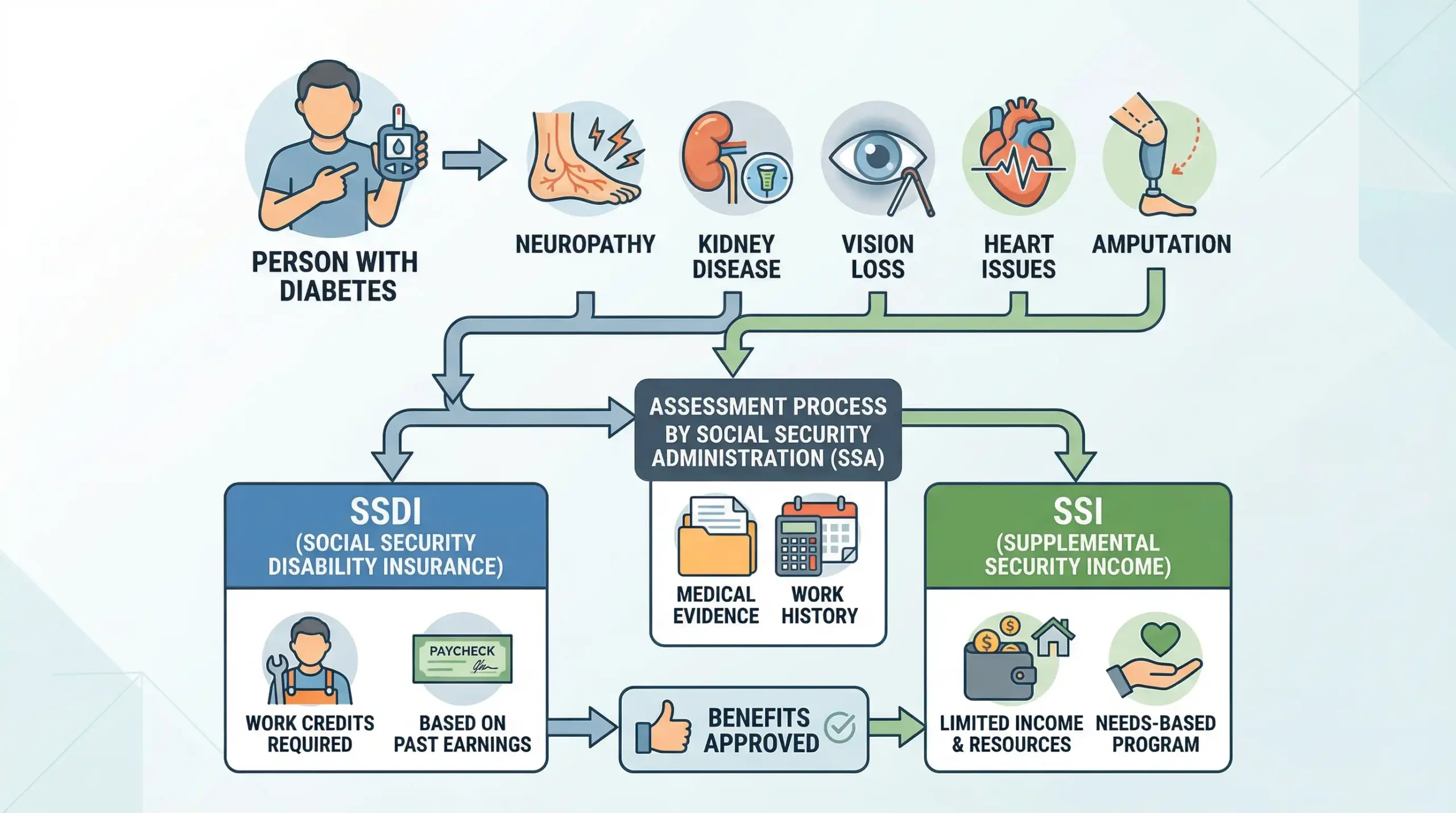
According to the Centers for Disease Control and Prevention (CDC), about 38.4 million Americans, that is 11.6% of the U.S. population, are living with diabetes. That is an enormous number of people who may need this kind of support at some point.
What Is a Medical-Vocational Allowance?
If your diabetes has not caused a condition that appears on the SSA’s official list but still makes it impossible for you to do any job, you might still qualify through something called a Medical-Vocational Allowance. The SSA will look at your residual functional capacity (RFC), basically, how much your body can still do. If the answer is “not enough to hold a job,” you may be approved.
This is why working with a disability attorney can help. They understand how to present your case and what medical evidence is needed.
Diabetes as an Invisible Disability
Why People Don’t Always See It as a Disability
One of the hardest things about living with diabetes is that it is often called an invisible disability. You can look completely healthy on the outside while your body is working overtime on the inside. People around you may not realize how much mental and physical energy it takes to manage blood sugar levels, watch what you eat, track insulin doses, and plan around your condition every single day.
Because of this, people with diabetes face a lot of stigma. Some people are told they “just need to eat better.” Others are made to feel like their condition is their own fault. This is not fair and it is not accurate. Diabetes is a complex chronic medical condition, it is not a lifestyle choice.
Some people with diabetes wear a hidden disability lanyard with a sunflower pattern. This is a quiet way of letting others know they may need extra support without having to explain everything out loud.
The Emotional Side of Living with Diabetes
Managing diabetes is not just physical, it takes a real emotional toll too. Worrying about blood glucose levels, dealing with hypoglycemia (low blood sugar), feeling tired all the time, and handling the financial cost of medication and monitoring supplies, all of this adds up.
To be fair, I think a lot of health guides skip this part. They talk about the legal rights and the medical facts, but they do not talk about how exhausting it can be to live with a condition that never takes a day off. If you are feeling overwhelmed, that is completely understandable.
Getting the right kind of professional support, from a doctor, a dietitian, or even a health coach, can make a real difference. If you want support that looks at the whole picture, not just your blood numbers, check out the services at Just Live Well, they work with people managing chronic conditions and focus on helping you feel better in your whole life, not just your diagnosis.
Conclusion
So, is diabetes a disability? Yes. Under the Americans with Disabilities Act, both Type 1 and Type 2 diabetes are considered disabilities because they substantially limit the endocrine system. This gives you real legal protections: at work, in school, and in public spaces. You have the right to ask for reasonable accommodations, the right to protection from discrimination, and depending on your situation, you may qualify for SSDI or SSI benefits if your complications are severe enough.
What matters most is that you know your rights, and that you do not face all of this alone. Living well with diabetes is possible, and having the right support around you makes it much easier.
Frequently Asked Questions
Is diabetes automatically a disability for Social Security purposes?
No, not automatically. Having diabetes alone usually does not qualify you for SSDI or SSI. You typically need to show that your diabetes complications, such as nerve damage, kidney failure, or vision loss, are serious enough to stop you from working. The Social Security Administration looks at your full medical picture, not just your diagnosis.
Can my employer fire me because I have diabetes?
No. Under the Americans with Disabilities Act, it is illegal for your employer to fire you, demote you, or treat you worse than other employees because of your diabetes. You are entitled to reasonable accommodations to help you do your job, and you are protected against disability discrimination in the workplace.
Does Type 2 diabetes count as a disability even without insulin?
Yes. Even if you manage your Type 2 diabetes through diet, exercise, or oral medication only, without any insulin, you are still protected under the ADA. The law looks at whether your endocrine system is substantially limited, not at what treatment you use.
Do I have to tell my employer that I have diabetes?
You do not have to share your diagnosis unless you want to ask for reasonable accommodations. If you do need accommodations, your employer may ask for medical documentation to confirm your need. However, they cannot legally use that information to discriminate against you.
What accommodations can I ask for at work if I have diabetes?
You can ask for scheduled breaks to check your blood sugar or take insulin, a private space for your medical needs, permission to keep snacks or juice at your desk to treat low blood sugar, and flexible scheduling for medical appointments. These are all considered reasonable accommodations under the ADA, and your employer is required to consider them.
